

The U.S. Army’s COSTA (Capability-Based Operations Sustainment Technology – Aviation) program set out to advance helicopter drivetrain health and usage monitoring beyond the capabilities of legacy HUMS systems (Health and Usage Monitoring Systems). A key objective was to integrate high fidelity onboard measurements with advanced diagnostic and prognostic tools, enabling earlier fault detection, reduced false alarms, and more efficient maintenance planning.
To support this effort, MagCanica was selected to provide precision flight-worthy torque measurement on a critical tail rotor drive shaft. High bandwidth, realtime torque data was essential for validating drivetrain loads and improving the performance of emerging diagnostic algorithms.
Challenge
COSTA required a torque sensing solution capable of delivering accurate, dynamic torque measurements in a demanding rotorcraft environment, in-flight. Implementing a magnetic torque sensor on this shaft introduced several technical challenges typical of new drivetrain measurement approaches, including:
- Ensuring an accurate and repeatable signal across the full operational torque range
- Maintaining accuracy under dynamic loading and temperature variation
- Integrating a digital torque stream into the program’s data acquisition architecture
The solution needed to provide maximum diagnostic value while minimizing added hardware and data handling burden — and it needed to be robust enough for full flight test deployment, not just laboratory evaluation.
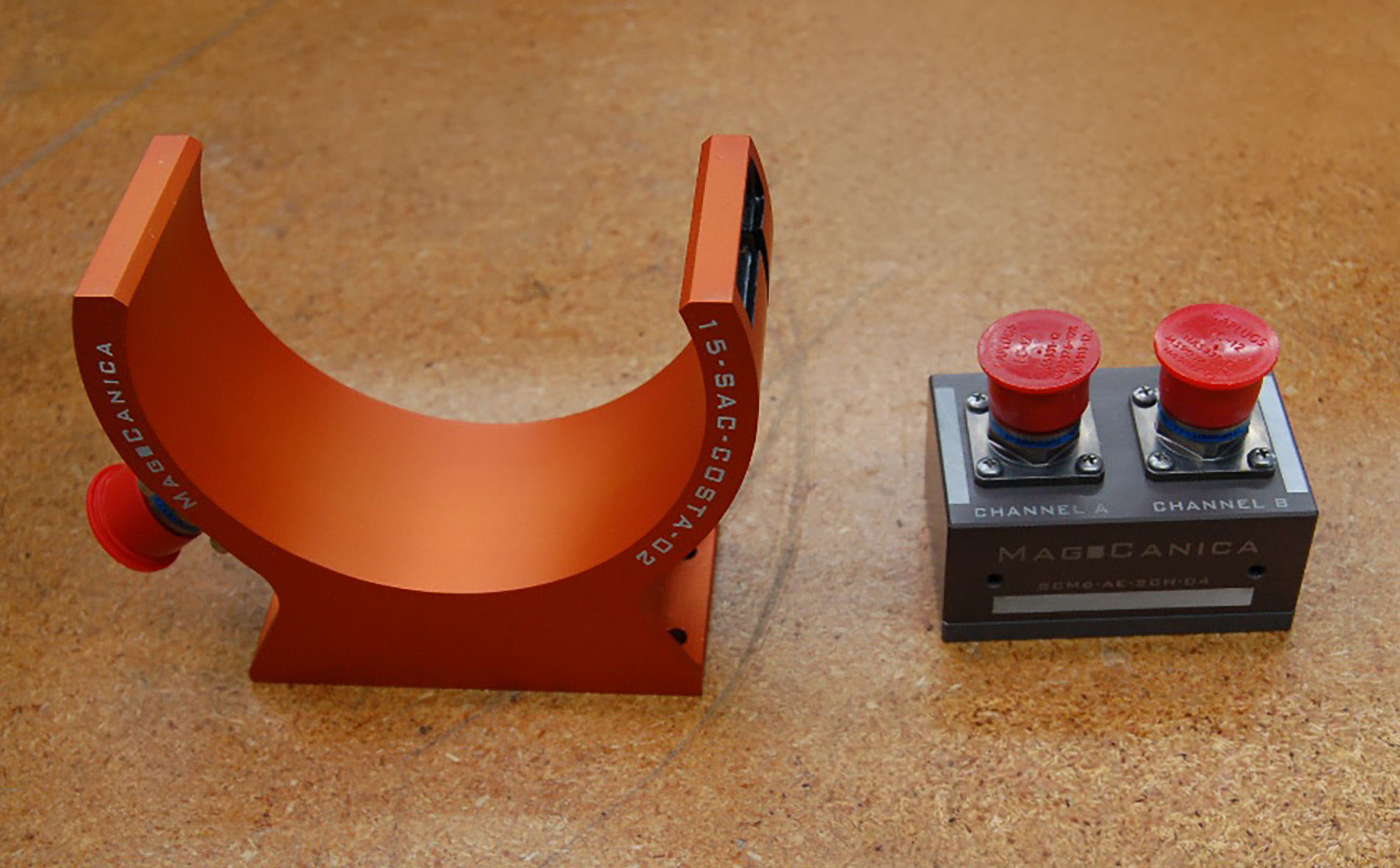
Torque Sensor Housing (left) and signal conditioning module (right) of the MagCanica helicopter tail rotor shaft torque sensor system
MagCanica’s Approach
MagCanica installed and calibrated its digital DSP based Signal Conditioning Module (SCM), a compact onboard processor that converts raw magnetic field measurements into a fully digital torque output.
The SCM provided:
- Realtime digital torque data over CAN bus
- High sampling rate (~1 kHz) suitable for dynamic drivetrain analysis
- Integrated filtering and compensation for magnetic, thermal, and rotational effects
- Calibration optimized for the operational torque range
Through detailed characterization of the sensor’s circumferential sensitivity and offset behavior, MagCanica ensured that the SCM’s digital output delivered accurate quasi steady torque while preserving high fidelity dynamic response.
Integration Into COSTA Flight Testing
Following calibration, the torque sensor and SCM were installed at the Helicopter Drive System test facility and remained in place for the entire drivetrain and propulsion Demonstration & Validation (DemVal) campaign, which included actual flight testing. This represented a major milestone: a fully digital, magnetoelastic torque sensor operating continuously on a flying rotorcraft platform.
Integration highlights included:
- Continuous digital CANbus torque data at ~1 kHz with ~350 Hz analog bandwidth
- Coinstallation of two reference sensors for validation:
- A straingauge torque bridge on the same rotating shaft
- A NAVAIR facility loadcell torque sensor at the Transmission Gearbox (TGB) output
- Alignment of all torque measurements to the gearbox input for direct comparison
Once reference sensor acquisition was fully enabled, synchronized datasets were collected across multiple ground and flight test events, enabling comprehensive validation of MagCanica’s digital torque output.
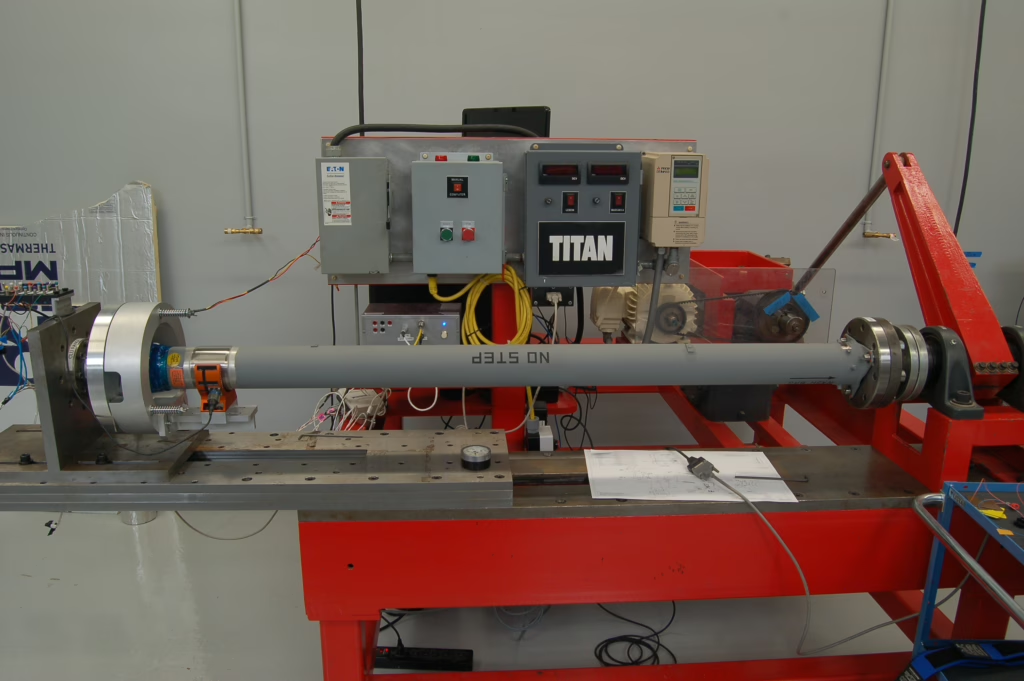
Figure 1 Test shaft installed on the torque testing rig at MagCanica. The sensor is the orange member radially located about the left side of the shaft
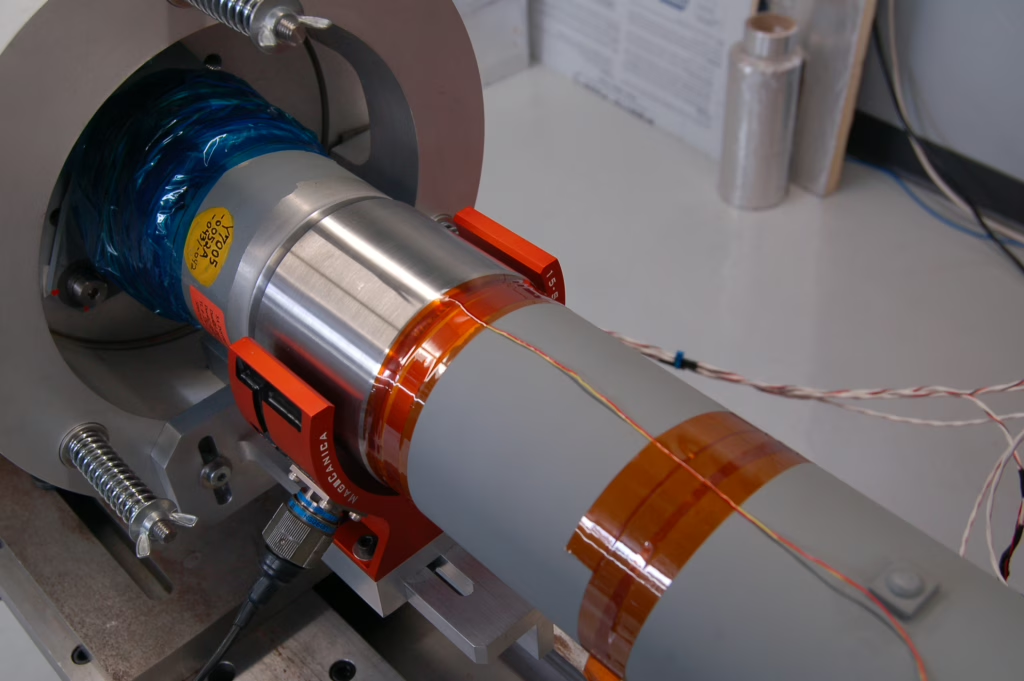
Figure 2 Image of the torque sensor located about the transducer region of the shaft
Results
Throughout the DemVal campaign — including the flight test phase — the MagCanica torque sensor and digital SCM delivered stable, high resolution torque measurements suitable for drivetrain diagnostics, load estimation, and algorithm development. The digital CANbus architecture provided clean, high bandwidth data with minimal integration overhead, supporting COSTA’s broader goals of improving drivetrain health monitoring and reducing maintenance burden.
Conclusion
MagCanica’s truly non-contact helicopter rotor shaft torque sensor and DSP based digital SCM played a central role in the COSTA drivetrain monitoring effort. By providing reliable, high bandwidth torque measurements through a modern digital interface — and demonstrating this capability in actual flight testing — MagCanica helped advance onboard diagnostics, validate drivetrain loads, and strengthen the foundation for next generation prognostic capabilities. This capability could also be leveraged for other locations in the helicopter driveline such as inside the transmission, or at the main rotor shaft. Furthermore, the MagCanica helicopter torque sensor system can be used for closed-loop attitude control to widen the envelope and increase the speed of execution rotorcraft maneuvers.